

Left-handed scissors have the blades arranged the opposite way to right-handed scissors. When you hold them in your left hand, this helps the blades press together as you cut and makes it easier to see the line you are following.
I'm Aya, the left-handed shop manager at HIDARI. I struggled with scissors as a child, and I still hear similar stories from left-handed customers. Here is how that small difference works, and how to choose a pair for what you want to cut.
Choosing a pair? Jump to scissors for paper, cooking, fabric and flowers.
How the blades work
The blade arrangement is reversed
Look at the two pairs below with the handles toward you and the tips pointing away. On the left-handed pair, the blade on the left sits on top where the blades cross. On the right-handed pair, the blade on the right sits on top. The difference is in how the two blades are assembled; turning a right-handed pair upside down does not make it left-handed.

Your grip helps keep the blades together
Scissors cut by bringing two blade edges past each other. As you close your hand, your thumb and fingers also put a little sideways pressure on the handles. This comes from your natural grip; you do not need to deliberately push the handles sideways.
With left-handed scissors, that pressure helps keep the blades in contact. With right-handed scissors in the left hand, it can push them apart slightly, so paper may fold between the blades instead of being cut.
You can see the cutting line more easily
The reversed blades also change your view. In the left hand, the upper blade of right-handed scissors can cover the line you are trying to follow. Left-handed scissors leave that line easier to see, so you have less need to tilt the scissors to look around the blade.

Handle shape is a separate consideration
Some scissors have handles shaped for one hand; others have symmetrical handles. A symmetrical handle can fit either hand, but it does not tell you whether the blades are arranged for left-handed cutting. Check the blade arrangement first, then choose a handle size that fits your fingers comfortably.

Choose scissors for what you want to cut
Once you have checked the blade arrangement, choose a pair made for the material you will be cutting. The examples below cover four common uses.
The pairs below are made in Seki and Sanjo, two Japanese cities with long traditions of blade-making and metalwork.
You can see every pair we carry in our left-handed scissors collection.
Paper and everyday tasks

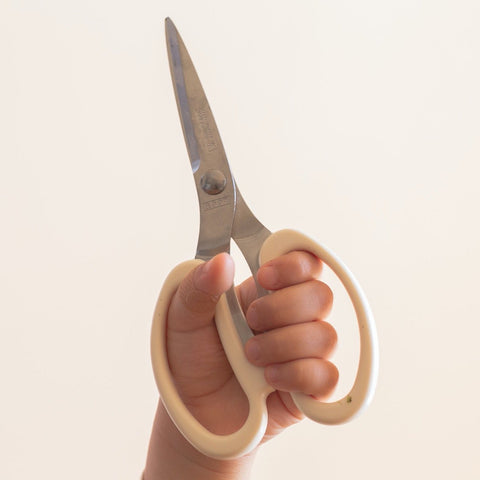
For paper, packaging and everyday crafts, ALLEX All-Purpose Scissors in the large size, made by Hayashi Cutlery in Seki, have long blades and generous handles suited to larger hands.
If you prefer a more compact pair for everyday paper cutting, see ALLEX All-Purpose Scissors in the medium size. Check the handle measurements on the product page for a comfortable fit.
Cooking and food preparation

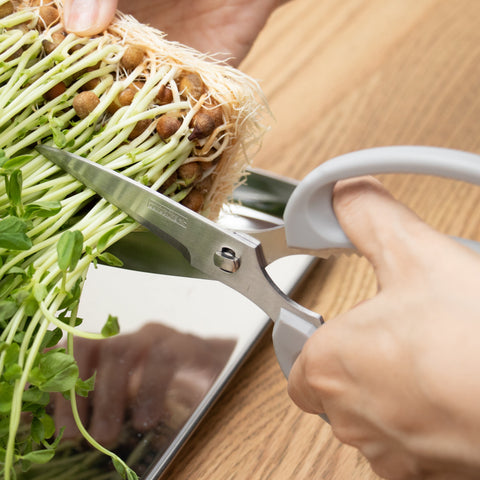
For food preparation, SUNCRAFT Easy-Clean Kitchen Shears, made in Seki, have serrated blades and come apart for washing; wash them by hand, as they are not dishwasher safe.
Fabric and sewing

For fabric laid flat on a table, SILKY Fabric Scissors, made in Seki, have long blades designed for guiding the cut along the work surface.
Fresh flowers

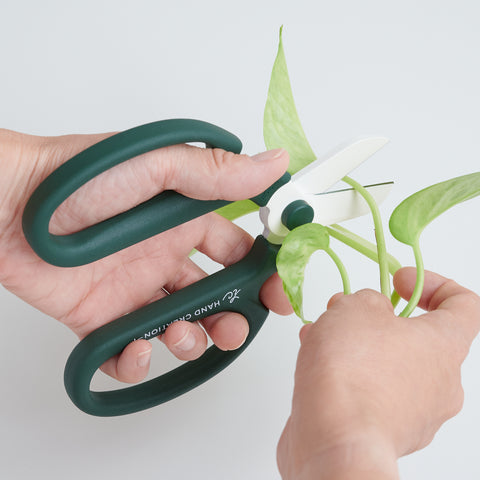
For trimming fresh flower stems, SAKAGEN Flower Scissors, from Sanjo, have lightweight handles and fluorine-coated blades that are easy to wipe clean after use. They are not suitable for branches, wire or thick paper.
For more options, including children's scissors and grooming scissors, see our left-handed scissors guide.
Getting used to left-handed scissors
If you have used right-handed scissors in your left hand for years, a left-handed pair may feel unfamiliar at first. You may have learned to tilt the scissors or squeeze the handles sideways to make them cut.
Start with a few slow cuts on a piece of paper. Keep the scissors upright and use a relaxed grip. Our tips for using left-handed scissors explain what to try if the new pair still feels awkward.
You can also watch the demonstration below from our sister shop in Japan. The video is in Japanese.